Wednesday, January 21, 2026

Ultimate Guide to Crypto Taxes in the US 2026: How to Pay Taxes on Cryptocurrency


crypto taxes in the US 2026


In the dynamic landscape of digital assets, mastering crypto taxes in the US 2026 is vital for investors, traders, and enthusiasts. As cryptocurrency continues to integrate into mainstream finance, the IRS has ramped up enforcement, treating crypto as property for tax purposes. Whether you're holding Bitcoin, trading Ethereum, or earning from DeFi protocols, understanding how to pay taxes on cryptocurrency in the US can prevent costly penalties and optimize your returns. This in-depth guide explores the technical and financial intricacies of cryptocurrency taxation in the US, including taxable events, calculation strategies, reporting forms, and cutting-edge tools. With new broker reporting rules via Form 1099-DA kicking in for 2025 transactions (filed in 2026), compliance is more critical than ever.Why Crypto Taxes Matter in the US: A Tech and Finance LensCryptocurrency leverages blockchain technology for secure, decentralized transactions, enabling innovations like smart contracts on Ethereum and NFTs on platforms like Solana. From a monetary perspective, crypto taxes in the US directly affect your portfolio's profitability—gains are taxable, but losses can offset other income, improving your financial position. The IRS classifies crypto as property under Notice 2014-21, meaning disposals trigger capital gains taxes.In 2026, non-compliance can result in audits, penalties up to 75% for fraud, or even criminal charges. Technologically, blockchain's transparency aids IRS tracking via tools like Chainalysis, but wallet privacy and cross-chain activities complicate record-keeping. Financially, strategic crypto tax planning in the US—such as tax-loss harvesting—can reduce your effective tax rate, freeing up capital for reinvestment.Key 2026 insights: Over 50 million Americans own crypto, per surveys, and the Infrastructure Investment and Jobs Act mandates broker reporting starting with 2025 sales, enhancing IRS oversight.Taxable Events: When Do You Owe Crypto Taxes in the US?The IRS taxes "dispositions" of crypto, where value is realized. Identifying taxable events in cryptocurrency is essential for accurate reporting.Taxable Crypto Transactions

  • Selling Crypto for Fiat: Converting BTC to USD on exchanges like Coinbase realizes capital gains based on the difference between sale price and cost basis.
  • Crypto-to-Crypto Trades: Swapping altcoins (e.g., ETH for USDT on Uniswap) is taxable, using fair market value (FMV) at the trade time.
  • Using Crypto for Purchases: Spending crypto via payment processors like BitPay triggers taxes on appreciation.
  • Mining and Staking Rewards: Income from proof-of-work (PoW) mining or proof-of-stake (PoS) staking is ordinary income at FMV upon receipt, plus self-employment taxes if it's a business.
  • DeFi Yields and Airdrops: Earnings from yield farming on Aave or free airdrops are taxable as ordinary income when controllable.
  • NFT Sales and Royalties: Disposing of NFTs or receiving creator royalties incurs capital gains or ordinary income taxes, with blockchain metadata aiding valuation.
Non-Taxable Crypto Activities
  • Buying Crypto with Fiat: Acquiring with USD isn't taxable—it's establishing a cost basis.
  • Holding (HODLing): Storing in hardware wallets like Trezor doesn't trigger taxes until sale.
  • Wallet Transfers: Self-transfers between wallets (e.g., exchange to personal) are non-taxable.
  • Gifting Crypto: Gifts under $18,000 (2025 annual exclusion) are exempt, but large gifts may require Form 709.
Tech tip: Use explorers like Blockchain.com to track transaction IDs. Financially, hold assets over a year to qualify for lower long-term rates, a key strategy in volatile markets.Calculating Your Crypto Taxes: Methods and FormulasHow to calculate crypto taxes in the US requires tracking cost basis and gains. The IRS allows FIFO (First-In-First-Out), LIFO (Last-In-First-Out), or Specific Identification, but consistency is key.Step-by-Step Calculation
  1. Establish Cost Basis: Include purchase price plus fees (e.g., gas fees on Ethereum) in USD, using historical rates from APIs like CoinGecko.
  2. Determine FMV: Use USD value at the exact time of disposition from reputable sources.
  3. Compute Gains/Losses: Gain = FMV - Adjusted cost basis. Short-term (<1 year) taxed at ordinary rates; long-term (>1 year) at preferential rates.
  4. Offset and Carry Forward: Losses offset gains; excess can offset up to $3,000 of ordinary income, with unlimited carryforward.
Example: Bought 1 BTC for $40,000 in 2024; sold for $60,000 in 2025 after holding >1 year. Long-term gain = $20,000. Tax at 15% (assuming bracket) = $3,000.Advanced tech: Integrate exchange APIs with scripts in Python (using libraries like pandas) for automated FIFO calculations. For 2026 filings (2025 taxes), brokers will report gross proceeds on 1099-DA; basis reporting starts for 2026 acquisitions.Alternative Strategies
  • Wash Sale Rule: Doesn't apply to crypto, allowing immediate repurchases after losses.
  • Like-Kind Exchanges: No longer valid post-2017 TCJA.
  • Donations: Donate appreciated crypto to charities for FMV deductions without realizing gains.
Financial optimization: Use Specific ID to select high-basis lots, minimizing taxable gains in high-volatility assets.Tax Rates, Exemptions, and Additional Levies in 2026For tax year 2025 (filed in 2026):
  • Short-Term Capital Gains: Taxed as ordinary income (10-37% based on brackets).
  • Long-Term Capital Gains: 0%, 15%, or 20% depending on income (e.g., 0% for singles under $47,025).
  • Net Investment Income Tax (NIIT): 3.8% on gains if MAGI exceeds $200,000 (single).
  • Self-Employment Tax: Up to 15.3% on mining/staking if considered a trade.
  • State Taxes: Vary; e.g., California taxes as income (up to 13.3%), while states like Texas have no income tax.
No federal VAT on crypto, but sales tax may apply to certain transactions. For non-residents, US-sourced crypto income may be taxable.
Filing Status
Short-Term Rates (Ordinary Income)
Long-Term Rates
Single
10-37%
0-20%
Married Joint
10-37%
0-20%
Reporting and Filing Crypto Taxes in the US: Forms and DeadlinesHow to report cryptocurrency taxes in the US is self-reported, with increased scrutiny via 1099 forms.Key Forms
  • Form 8949: Detail each transaction's gains/losses.
  • Schedule D: Summarize totals for Form 1040.
  • Form 1040 Schedule 1: Report crypto income (e.g., mining).
  • Form 1099-DA: New for 2025 sales; brokers like Coinbase report gross proceeds (basis added for 2026+).
Filing Deadlines
  • Individual Returns: April 15, 2026 (for 2025 taxes); extensions to October 15.
  • Estimated Payments: Quarterly if expecting >$1,000 owed.
Tech tool: E-file via IRS Free File or software with digital signatures. Financial advice: Hire a CPA for complex DeFi activities to avoid audits.Best Tools and Software for Crypto Tax Management in the USHarness technology for crypto tax software in the US. These integrate with blockchains and wallets for seamless compliance.
Tool
Features
Pricing
US-Specific
CoinLedger
API sync, 1099-DA support, loss harvesting
$49-$299/year
Yes, IRS forms export
TokenTax
DeFi analytics, NFT tracking
$65-$3,500/year
Handles NIIT calculations
TurboTax Crypto
Integrated filing, airdrop valuation
$0-$89
Direct IRS e-file
Koinly
Multi-chain support, FIFO/LIFO options
€49-€199/year
US tax reports
Money tip: Simulate scenarios to optimize for long-term rates, potentially saving thousands.Advanced Topics: Tech Innovations and Financial Strategies
  • Blockchain Analytics: Use tools like Dune for DeFi transaction logs.
  • DeFi Tax Nuances: Track impermanent losses in liquidity pools; IRS may classify some yields as ordinary income.
  • Tax Optimization: Relocate to low-tax states or use Roth IRAs for crypto (if eligible).
  • 2026 Updates: With 1099-DA basis reporting, expect easier compliance but stricter enforcement; prepare for potential stablecoin regs.
For expats, FATCA requires reporting foreign holdings over $50,000.Conclusion: Navigating Crypto Taxes for Optimal Financial OutcomesTackling crypto taxes in the US 2026 combines blockchain tech with savvy financial planning. By grasping how to pay taxes on cryptocurrency, leveraging advanced tools, and employing strategies like long-term holding, you can minimize taxes and enhance gains. Stay ahead with IRS.gov updates, as regulations evolve. For tailored guidance, consult tax professionals—empower your crypto journey in this decentralized financial revolution.This guide arms you with essentials for cryptocurrency taxation in the US. Verify with official sources for the latest.

Monday, January 19, 2026

Blockchain Council Announces Community Partnership with Unchained Summit Dubai 2026


unchained summit dubai 2026
  • Michael Willson
  • January 19, 2026

Blockchain Council is excited to announce its role as Community Partner for Unchained Summit Dubai 2026, a global Web3 and Blockchain conference taking place on 1–2 May 2026 in W Dubai, the Palm. The summit positions itself as a high impact meeting point for builders, investors, enterprises, and policymakers shaping the future of decentralized technologies.

With Dubai continuing to establish itself as a global blockchain hub, Unchained Summit Dubai 2026 is expected to attract a strong international audience focused on real adoption, innovation, and long term growth.


What to Expect at Unchained Summit Dubai 2026

Attendees can expect two days of focused discussions, curated networking, and deal driven conversations. The event format emphasizes quality over scale, with structured investor founder meetings, closed door roundtables, and deep dive panels designed for practical outcomes.

Core topics include institutional blockchain adoption, real world asset tokenization, DeFi evolution, AI and Web3 integration, compliance, and global regulatory frameworks.

Notable Speakers and Industry Voices

The summit will feature a strong lineup of founders, executives, and thought leaders from across the Blockchain ecosystem. Early announced speakers include leaders from Trust Wallet, NEAR Foundation, Blockdaemon, Coinbase Asset Management, Animoca Brands, Coin Bureau, and regional blockchain authorities.

More speakers from infrastructure providers, investment firms, enterprises, and policy organizations are expected to be announced closer to the event.

Why Attend

Unchained Summit Dubai 2026 is for professionals who want more than surface level conversations. Reasons to attend include:

  • Direct access to global investors and decision makers
  • Insights into institutional and enterprise blockchain use cases
  • Clear perspectives on regulation and compliance across regions
  • High quality networking with founders, developers, and executives
  • Exposure to emerging trends shaping the next phase of Web3

Blockchain Council’s Role as Community Partner

As Community Partner, Blockchain Council will actively support the summit. The council will do so by engaging its global network of Blockchain professionals, learners, and industry leaders. The partnership aims to amplify knowledge sharing, encourage meaningful collaboration, and help attendees gain practical value from the event.

Blockchain Council’s involvement aligns with its mission to advance blockchain education and support responsible adoption worldwide.

Looking Ahead

The collaboration between Blockchain Council and Unchained Summit Dubai 2026 signals a shared vision for building a stronger, more informed Web3 ecosystem. Additional announcements around community initiatives, sessions, and engagement opportunities will come later to lead up to the summit.

Blockchain Council invites its community and partners to join this landmark event. It’s your chance to be a part of the conversations defining the future of Blockchain and Web3.

Source www.blockchain-council.org/events/blockchain-...

Friday, January 16, 2026

Transform Your Marketing and Communication Strategy with The Push and The Boost at Markethive.


Markethive is engineered to deliver a comprehensive, cohesive digital marketing framework, equipping modern entrepreneurs with unparalleled reach and diverse opportunities, all seamlessly integrated into the proprietary Markethive ecosystem. Key to this approach are the currently integrated "Boost" system and the forthcoming "Push" system. Together, the Boost and Push systems form a dynamic duo, offering entrepreneurs a complete spectrum of digital marketing capabilities, all managed and executed within the unified, entrepreneur-centric Markethive platform.

These systems, inspired by Facebook's Boost function, are a core element of the Markethive ecosystem. They are designed to significantly amplify your marketing reach among Markethive subscribers, offering immense potential to boost brand awareness, drive conversions, and increase engagement.

However, Markethive operates on a principle of complete, organic reach, fundamentally distinguishing it from the restrictive models of mainstream social media platforms. Its standard news feed already ensures that every one of your posts is delivered directly to the news feeds of 100% of your friends and all members of your associated groups. This core feature eliminates the artificial constraints and commercial pressures that dominate other platforms.

Crucially, Markethive is designed without the restrictive, often opaque algorithms used by Facebook et al, which actively filter, suppress, and prioritize content based on undisclosed criteria or paid promotion. At Markethive, there is no underlying system that prevents your posts from reaching your intended audience. 

Furthermore, the platform explicitly rejects practices such as "shadow banning," where a user's content is made invisible to others without their knowledge. There is no third-party or proprietary system dictating or censoring the content you can see, share, or engage with. This commitment ensures a truly decentralized, transparent, and high-engagement experience for all users.

The Push: Amplifying Your Message to New Members

The "Push" feature coming to Markethive provides a powerful, direct channel to ensure your message reaches every new member who joins the platform. This strategic placement guarantees maximum visibility and immediate exposure for your content, establishing an early connection with the platform's latest members.

How The Push works:

When you utilize the Push feature, your message is prominently displayed to all new members as they onboard into the Markethive ecosystem. This means that, as soon as a new individual registers and logs in, your communication will be among the initial pieces of content they encounter. It also means new members will have an active newsfeed right from the start. 

Benefits of Using The Push:

  • Immediate Exposure: Your message is seen by new members at the very beginning of their Markethive journey, making an immediate impact.
  • Guaranteed Visibility: Unlike other posting methods, where content can be missed, the Push ensures your message is displayed to every new member.
  • Strategic Onboarding: Leverage this feature to introduce new members to your initiatives, products, services, or community groups right from the start.
  • Enhanced Engagement: By reaching new members early, you can encourage immediate engagement and participation in your offerings.
  • Building Brand Awareness: Establish your presence and brand identity with new members from day one.

Crafting Your "Push" Message:

Given the prime real estate your message occupies, it's crucial to craft content that is concise, impactful, and clearly communicates its purpose. Consider what you want new members to know or do immediately upon joining Markethive. This could be:

  • A welcoming message to your specific group or community.
  • An introduction to a key product or service.
  • An invitation to an upcoming event or webinar.
  • A call to action for a free resource or download.
  • An essential piece of information for navigating the platform.

By strategically utilizing The Push, you can effectively amplify your message and cultivate a strong, immediate connection with the growing Markethive community. It ensures new members immediately see your message upon registration, offering guaranteed visibility and immediate exposure. It helps with strategic onboarding, enhanced engagement, and building brand awareness by introducing initiatives, products, or groups from day one.   


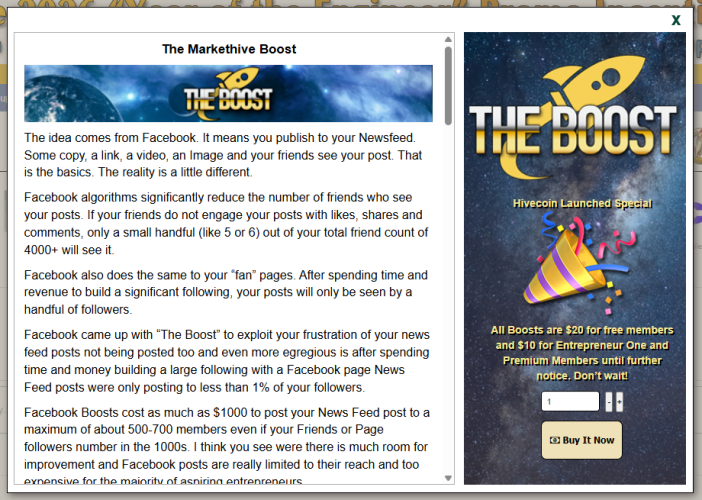
The Sales Page Pop-up 

The Boost: Amplifying Your Message Across Every Member's News Feed

In today's hyper-connected yet intensely competitive digital landscape, capturing and retaining audience attention is the ultimate challenge. The sheer volume of information being produced creates digital clutter, making it increasingly difficult for critical communications to cut through the noise and achieve genuine visibility. For organizations, businesses, and creators, this often means that vital announcements, strategic updates, and high-value content can be overlooked, diminishing their intended impact.

This is precisely where the Boost steps in, offering a revolutionary, unparalleled solution to systematically overcome these digital barriers. It is more than a delivery system; it is a meticulously engineered, proprietary mechanism built to guarantee content exposure.

How The Boost Works:

  • Bypassing the Algorithm: Unlike standard content distribution methods that rely on unpredictable, often restrictive platform algorithms that frequently filter, delay, or suppress messages, the Boost is designed to bypass these bottlenecks entirely.
  • Direct-to-Feed Delivery: The core functionality of this feature is to ensure your content is delivered directly to the news feeds of every member of your intended audience. This is a non-negotiable guarantee of presence. Every eyeshot, every scroll, will include your message.
  • Catalyst for Impact: As a powerful digital catalyst, the Boost dramatically enhances both the visibility and the overall influence of your communications. It transforms mere content posting into strategic, high-impact distribution.

The Essential Benefits:

  1. Guaranteed Visibility: Eliminate the risk of critical messages being missed. The Boost ensures 100% reach to the entire membership base, providing total confidence in your communication strategy.
  2. Enhanced Engagement: By ensuring direct exposure, the feature sets the stage for a significant increase in readership, interaction, and subsequent action from your audience. When people see the message, they can act on it.
  3. Maximum Impact: Whether it is a product launch, a crucial policy change, an urgent operational update, or a key community announcement, the Boost emphasizes the weight and urgency of your message, making its importance instantly clear and prompting immediate action.

By utilizing the Boost, you transition from hoping your message is seen to knowing it is delivered, cementing your place as a consistent and authoritative source of information in the rapid flow of the digital world.

Maximize Your Reach: The Unrivaled Power of The Boost

Imagine the impact of knowing that every member sees your latest newsletter, a substantial policy change, an exciting new event, or a crucial service update. The Boost turns this vision into reality, making your communication strategy more effective and your audience more informed. It empowers administrators and communicators to deliver messages with confidence, knowing they will be seen, absorbed, and acted upon.

In essence, the Boost is more than just a publishing tool; it's a strategic advantage that empowers you to communicate with unparalleled reach and impact, fostering a more connected, engaged, and informed member community. It serves as a PA system for communicating with the entire membership, not just your friends and associates. If they like your message and subscribe to you, you are then publishing to their sphere of influence and social networks.

The Markethive Boost feature is evolving to offer more targeted publishing options, including the ability to publish to specific geographic locations. Pricing will be tiered based on the delivery method, such as targeting via hashtags, keywords, most active users, or number of friends, but not via private navigation. The Boost feature will also be incorporated into the Promo code incentive. This allows you to offer it to prospects who join Markethive, as well as to existing members who join your groups and make purchases in your store.

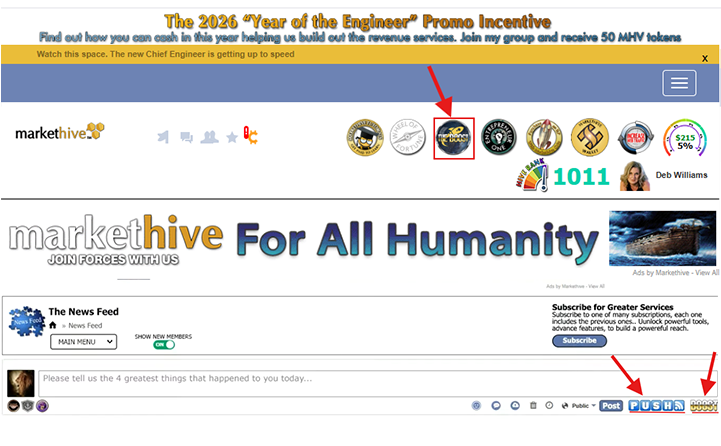
Currently, the Boost allows any post to appear on every member's News Feed for a flat fee. For the launch period, the cost is $20 for free members and $10 for Entrepreneur One upgraded members. These launch prices will remain in effect until further notice. To get started, simply click the Boost icon located in the top tray of the Markethive home page. A sales page will pop up, allowing you to select the number of Boosts you want.


The Boost and Push icons will be displayed in the updated newsfeed under your editor. 

 
An Epic Ecosystem In The Making

The Push and The Boost are subscription-based services that contribute to a much larger, multifaceted revenue-generating system designed to establish a robust, resilient financial foundation. It provides the predictable, recurring resources needed to support long-term operational and iterative goals and key initiatives, such as the ILP interest payouts. 

The intensive iteration and development phase for Markethive, our next-generation social commerce and marketing platform, is progressing, bringing us closer to a fully operational and revenue-generating system. However, to ensure a swift and successful transition from development to full-scale launch, and to fully capitalize on the foundational work already accomplished, additional strategic funding is necessary.

This crucial investment is not merely about maintenance; it is specifically earmarked for the final, intensive development sprints required to integrate advanced features, optimize the user experience, and stress-test the platform under real-world conditions. Securing this funding will directly enable us to:

  • Accelerate Product Launches: Bring key, highly anticipated features, such as the crypto exchange listings for Hivecoin, a peer-to-peer marketplace, and advanced marketing automation tools, to market much faster than currently projected.
  • Meet All Development Objectives: Fully complete the Markethive platform's scope, ensuring a robust, scalable, and secure system that can handle massive user growth from day one.
  • Ensure a Polished User Experience: Dedicate resources to final quality assurance, bug resolution, and user interface (UI) refinements, guaranteeing a world-class experience for all members.

By contributing now, you are not simply donating; you are securing your direct stake in the platform's future success and profitability. We offer various contribution methods, some designed to give contributors a significant, long-term stake in the Markethive ecosystem. Your support will be the catalyst that transforms our current progress into a fully realized, revolutionary market network platform ready to generate substantial revenue. There are several ways to support us.

  • Secure an E1 Subscription (New Members): This is the ideal time to become an E1 member. A limited number of non-expiring E1 subscriptions are available, securing your access to all E1 benefits, including becoming an ILP shareholder and receiving 0.01 ILP annually, as long as your account remains active. Purchasing an E1 directly supports our development.
  • Expand Your E1 Subscriptions (Existing Members): Current E1 members can significantly accelerate product launches and monthly dividend payments to ILP holders by purchasing additional E1 subscriptions.
  • Direct Initial Loan Procurement (ILP) Purchase: Individuals interested in a basic, direct investment in the platform's future can buy an ILP separately. Please reach out to the Administration for more information.
  • Maintain Active Engagement: Your participation in the ecosystem is crucial. We encourage you to:
    • Purchase Boosts and Vanity Promo Codes: These tools are essential for expanding your marketing reach and increasing conversions.
    • Stay Active in the Wheel of Fortune Game: This activity helps boost system energy, increases transaction volume, and rewards your efforts.

Join us as we move forward with the next-generation multidimensional media platform, Markethive. Welcome to the Entrepreneur’s ecosystem. We are built for Entrepreneurs by Entrepreneurs and are made up of Entrepreneurs of every caliber.


Thank you for your ongoing support. God bless you.


Wednesday, January 14, 2026

Singapore Crypto Tax Guide 2026


Singapore Crypto Tax Guide
Michelle Legge
By Michelle Legge • Head of Crypto Tax Education
Updated Jan 6, 2026
This article has been fact checked and reviewed as per our editorial policy.

Singapore Crypto Tax Guide 2026

Our Singapore Crypto Tax guide covers everything you need to know about the tax rules in Singapore, including capital gains, business income, and more.

  • Singapore is a very crypto tax-friendly country, as there is no Capital Gains Tax for individual investors.

  • However, if you’re trading crypto frequently and at scale, your profits may be considered business income.

  • Income Tax applies to business income, as well as crypto received as payment for goods and services.

  • Any taxable income from crypto must be reported by April 18 each year.

This guide is regularly updated...

Is crypto taxed in Singapore?

For individual investors, there is no capital gains tax or income tax on crypto, making Singapore one of the most tax-friendly countries in the world.

How much tax do you pay on crypto in Singapore?

Individual investors pay no tax on profits from crypto. Meanwhile, profits from professional trading may be considered business income and taxed at up to 24%.

Additionally, an 8% Goods and Services Tax (GST) may apply on fees when you purchase, sell, or trade cryptocurrencies that are not officially classed as digital payment tokens.

How is crypto taxed in Singapore?

Tax on crypto in Singapore depends on whether you’re an individual investor or a trader with business income, as well as the type of token you’re investing in.

Individual investors pay no tax on profits, but if you’re investing like a trader, for example, with frequent short-term profits, this may be classed as business income and subject to tax.

As well as this, an 8% GST may apply to transaction fees on cryptocurrencies that are not classed as digital payment tokens.

It can all get a little convoluted, so let’s break it down.

Capital gains vs. business income

Profits from your trading activity may be classed as income, even if you don’t have a business entity set up.

The Inland Revenue Authority of Singapore (IRAS) may classify profits as business income when your activities extend past personal investment. This is decided on a case-by-case basis, but the IRAS looks at several factors to decide this, including:

  • The frequency and volume of your trading activity.

  • The holding period of your assets.

  • The organisation of your trades.

  • Supplementary work, such as marketing efforts.

  • The intention behind purchases.

In summary, if you’re holding for long periods and trading infrequently, your profits will likely be tax-free as an individual investor. Whereas if you’re trading short-term frequently, at volume, and in a structured manner with an intent to make a profit, your profits may be taxable business income. 

You should speak to an experienced crypto accountant in Singapore for advice on your individual circumstances.

Tax rates on business income

If you do have taxable business income, your tax rate varies depending on whether you’re a resident or non-resident. Residents will pay up to 24% depending on their total annual income:


Taxable Income (SGD)Tax Rate
Up to $20,0000%
$20,001 – $30,0002%
$30,001 – $40,0003.5%
$40,001 – $80,0007%
$80,001 – $120,00011.5%
$120,001 – $160,00015%
$160,001 – $200,00018%
$200,001 – $240,00019%
$240,001 – $280,00019.5%
$280,001 – $320,00020%
$320,001 – $500,00022%
$500,001 – $1,000,00023%
Over $1,000,00024%

If you’re not a resident, most of your income is taxed at 24%. If it’s a regular job salary, it can be taxed at 15% flat or the same way as residents (with deductions), whichever gives the government more tax. If you’re a non-resident director, you don’t get the lower rate; 24% tax is taken straight out of your director’s pay.

Tokens and GST

For digital payment tokens (DPTs) like Bitcoin, Ether, Litecoin, Ripple, and so on, since January 2020, buying, selling, or swapping them is exempt from GST. That means if you trade DPTs for other DPTs, or convert them into dollars, there’s no GST. 

However, for other tokens, not classed officially as digital payment tokens, an 8% GST may apply on transaction fees.

How are different transactions taxed in Singapore?

With the basics out of the way, let’s take a look at how some common crypto transactions may be taxed.

Buying, holding, transferring

Tax-free. However, 8% GST may apply to crypto transaction fees where tokens are not classed as digital payment tokens.

Selling

Tax-free for individual investors. 8% GST may apply to fees for non-digital payment tokens. Income Tax if profits are categorized as business income.

Trading

Tax-free for individual investors. 8% GST may apply to fees for non-digital payment tokens. Income Tax if profits are categorized as business income.

Spending

Buying something with cryptocurrency is tax-free in Singapore. GST may apply to fees depending on the type of token. GST may apply to the goods themselves.

Mining rewards

Mining rewards for hobby miners will generally be tax-free upon receipt and if later sold.

For those mining crypto as a business, profits will be classed as business income and subject to Income Tax.

Staking rewards

If you earn more than $300 (SGD) annually, your staking rewards will likely be subject to Income Tax.

Lending interest

If you earn more than $300 (SGD) annually, any interest or rewards from lending crypto will likely be subject to Income Tax.

Are crypto losses tax-deductible?

Just as capital gains or income from crypto are not taxable in Singapore, losses are not deductible. 

If you’re running a business, you may be able to deduct crypto losses against income.

How to report crypto on taxes in Singapore

If you have income from crypto, you’re required to report it on your tax return, whether you’re a resident or non-resident.

In Singapore, the financial year is the same as the calendar year (January 1 to December 31), so you’ll report income from this period in your tax return. The deadline to file is April 15 for paper filing and April 18 for e-filing.

To file, you need to group all your crypto transactions into two categories:

  • Crypto used for money, goods, or services

  • Crypto investment gains

You can see the applicable forms you may need on the IRAS site.

How a crypto tax calculator like Koinly can help…

Koinly is a crypto tax calculator that can help you calculate your gains, losses, income, and more, as well as generate tax forms, to help you easily file with the IRAS, or to hand over to your accountant. 

Koinly supports more than 900+ exchanges, wallets, and blockchains to make importing your transaction data easy and supports SGD, as well as all common accounting methods.

Source of the article Koinly 

Sign up to Koinly for free today  


Tuesday, January 13, 2026

The New Economy


The New Economy

BY Patricia White | December 19, 2025 | read / Exclusive Interviews

A conversation with John Fleming on freedom, flexibility and the future of work.

For decades, John T. Fleming has been one of the most influential thinkers in direct selling—an author, researcher, strategist and passionate advocate for the power of enterprise to change lives. His earlier landmark work, Ultimate Gig, helped the channel understand the rapidly expanding gig economy and the shift toward flexible, self-directed work.

Recently, John released his latest book—NEW ECONOMY—a sweeping, research-backed exploration of how work, choice and opportunity have transformed since 2018. The book examines millions of people moving toward independent work; the rise of multi-gig earners; the redefinition of employment; and the foundational role direct selling can play in this new era.

I sat down with John to talk about what motivated NEW ECONOMY, what he discovered and what direct selling companies might benefit from as they navigate—and lead—in this evolving landscape.

You’ve written extensively about the gig economy over the years. What inspired you to write NEW ECONOMY now?

The motivation came from a growing realization that something much bigger than the gig economy was unfolding. For years, I’ve spent countless hours reading, studying and gathering data—never for entertainment, always for learning. Eventually, the reservoir of insight became too deep not to share.

When I worked with our research team beginning in 2018, leading to Ultimate Gig, I learned far more than I could ever give back. We approached that project academically, and it introduced many to the idea that work could be defined differently—by freedom, flexibility and personal choice.

But the world changed dramatically in the years that followed. Technology accelerated; worker expectations shifted; and participation soared. At the end of 2024, more than 70 million people were estimated to be involved in gig or independent work, and projections show more than 100 million will participate by 2027.

At some point during the past six months, it felt like the insights were overflowing. I wanted to consolidate what we now know, provide evidence, stimulate thinking and help people see that we are inventing something entirely new—not just a new way to work, but a new economy.

You say we’re inventing a new economy. What do you mean by that?

We are entering an era where the worker owns a portion of the work. That is a profound shift.

In the traditional model, a company defined how, when and where work was done. The worker had little control. But now, through technology and decentralized structures, independent contractors are becoming independent entrepreneurs. They choose when they work. They choose how they work. And increasingly, the choices made relative to work are multiple, not singular.

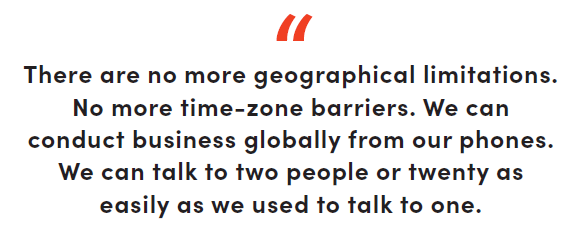
We’ve removed many of the obstacles that once constrained people. There are no more geographical limitations. No more time-zone barriers. We can conduct business globally from our phones. We can talk to two people or twenty as easily as we used to talk to one. All of this enables people to design their own work, often blending traditional employment with multiple income streams.

This ability to choose—to design one’s own work—creates what I describe as uncommon freedom. And when freedom becomes possible, people rarely give it up.

What were some of the most surprising insights you uncovered as you researched this transition?

One major insight was the sheer diversity of independent workers. There is no average gig worker—that’s a myth. People participate in the new economy for vastly different reasons: supplemental income, lifestyle freedom, creative expression, autonomy or simply to feel more in control of their future. Because motivations differ, levels of satisfaction also differ. Trying to assess through averages is misleading, especially averages that attempt to use income as a metric.

Another key insight is the scale of adoption across age groups. Many assume this movement is youth-driven. But the fastest growing segment of workers today is actually people 60 and older, who want control, continued relevance and flexible ways to supplement retirement. For many, retirement is not possible in the same manner that it may have been viewed 50 years ago. Younger generations, of course, also find flexible work to be natural—many are puzzled that work was ever defined as a physical location tied to fixed hours.

Finally, the growth rate surprised even me. When we first began studying the gig economy, participation was around 50 million. Today it’s approximately 70 million. Soon it will pass 100 million. That kind of acceleration reshapes labor markets, consumer expectations and business models.

How did your personal learning process shape the way NEW ECONOMY is written?

I believe deeply in the value of stepping outside the jar—a metaphor I use often. When we’re inside the jar, we can’t read the label. We don’t see ourselves clearly. We don’t see the outside environment clearly. So, I made a conscious decision in 2019 to climb outside the jar and study the gig economy with fresh eyes. That perspective is what enabled the writing of Ultimate Gig, and ultimately this new work.

The purpose of NEW ECONOMY is threefold:

  1. Provide enough stats and facts to support any assertions.
  2. Stimulate thinking through new perspectives.
  3. Activate the audience—encourage them to feel proud of what they’re doing or to start something new if they’re not yet participating in this economy.

I wanted this to be a book that makes people think differently about possibility.

You dedicate an entire chapter to direct selling. Why did you feel it was important to highlight this channel?

Because direct selling is unique—and uniquely aligned with the principles of the new economy.

It is one of the few models where the individual can truly own a piece of the work. The company provides the brand, the marketing, the product, the infrastructure. The direct seller provides the relationship. And that relationship adds tremendous value—value that traditional retail cannot replicate.

Direct sellers benefit not just from a single transaction, but from the lifetime value of customers they acquire, serve and retain. They also benefit when they influence others who choose to become direct sellers. This ability to build residual value is powerful. It is rare. And it is why we recommend direct selling as a preferred pathway within the broader new economy—not the only path, but a uniquely compelling one.

In many ways, direct selling was the original gig. But in this era, the opportunity is even greater.

Given the explosive growth of independent work, what does market share look like for direct selling?

If we look at participants—not retail sales—we can compare apples to apples. The US has about seven million direct selling participants. The gig economy has about 70 million. That’s a 10 percent market share.

Imagine if we increased that to 12 percent…15 percent…even 20 percent. The growth opportunities for the channel would be extraordinary.

But to earn that growth, we must be clear about who we are, how we operate and the value we deliver. Residual income, personal relationships, low cost of entry, flexibility, skill development, community—these advantages are significant. When communicated well, they position direct selling not as an alternative to employment, but as a meaningful component of an individual’s portfolio of work.

You’ve often emphasized customer acquisition and retention as essential. How does that connect to the new economy?

In any business model, there is no sustainable income without customers. That is as true for McDonald’s as it is for direct selling. McDonald’s counts burgers. We must count customers.

One of the most exciting opportunities in today’s marketplace is the shift toward personalized commerce—consumers buying from or because of the influence of someone they know and trust. Direct selling is perfectly positioned for that shift. But it requires disciplined focus on delivering value to customers and maintaining the relationship—not just completing the first transaction.

If we embrace simplicity, clarity and transparency—especially around how customers benefit—we not only remain competitive, we become a preferred model.

You’ve said that simplicity is a strategy. What does that mean for direct selling companies?

It means we must design our businesses so simply that people immediately understand them.

We live in a world with shortened attention spans, endless noise and constant distraction. If a compensation plan, onboarding process or customer experience feels complicated, people will not lean in—they will leave. In this economy, simplicity is the new gold standard.

Yet simplicity is incredibly difficult to create. It requires discipline, constant refinement and a willingness to remove rather than add. But the companies that master simplicity will win.

Another major theme in your research is that many independent workers engage in multiple gigs at once. What are the implications for our channel?

This is one of the most important mindset shifts for direct selling leadership.

Historically, some companies imposed restrictions—non-competes, exclusivity expectations, limits on outside activity. But the world has changed. It is contradictory to call someone an independent contractor while restricting how independent they are allowed to be.

People today value brand flexibility, not brand monogamy. They piece together income streams that match their goals. The question for us is not, “How do we keep people from engaging elsewhere?” but rather, “How do we become their preferred choice?”

That requires confidence in our brand, our opportunity and the value we provide. And it requires honoring freedom of choice—the very foundation of the new economy.

What do you believe is the single most important thing direct selling companies can benefit from in the new economy?

Success starts with thinking. Our thinking is enhanced when supported by good research and subsequent study. Too often, we try to solve a problem before fully understanding it. When we pause, observe the environment/the real situation, honestly examine the current situation of the business and then make decisions with clarity and intention, we increase the probability that we will succeed with the new decisions that we make.

The new economy is full of new possibilities to leverage the opportunity to benefit from relationships formed with both customers and partners attracted to direct selling companies. Direct sellers actually own a share of this relationship. This opportunity can be the competitive advantage that direct selling companies can emphasize. Direct selling, typically, does not stop with a transaction. As I have stated before; the opportunity to influence and own (via commissions) a portion of the relationship is most unique with direct selling models.

Over my many years of participation, observation, serving the direct selling business model directly and indirectly, the direct selling business model is in the best position that it has ever been, to become a preferred choice in the new economy…certainly from this perspective!

 
source   https://www.directsellingnews.com/2025/12/19/the-new-economy/