Tuesday, January 13, 2026

The New Economy


The New Economy

BY Patricia White | December 19, 2025 | read / Exclusive Interviews

A conversation with John Fleming on freedom, flexibility and the future of work.

For decades, John T. Fleming has been one of the most influential thinkers in direct selling—an author, researcher, strategist and passionate advocate for the power of enterprise to change lives. His earlier landmark work, Ultimate Gig, helped the channel understand the rapidly expanding gig economy and the shift toward flexible, self-directed work.

Recently, John released his latest book—NEW ECONOMY—a sweeping, research-backed exploration of how work, choice and opportunity have transformed since 2018. The book examines millions of people moving toward independent work; the rise of multi-gig earners; the redefinition of employment; and the foundational role direct selling can play in this new era.

I sat down with John to talk about what motivated NEW ECONOMY, what he discovered and what direct selling companies might benefit from as they navigate—and lead—in this evolving landscape.

You’ve written extensively about the gig economy over the years. What inspired you to write NEW ECONOMY now?

The motivation came from a growing realization that something much bigger than the gig economy was unfolding. For years, I’ve spent countless hours reading, studying and gathering data—never for entertainment, always for learning. Eventually, the reservoir of insight became too deep not to share.

When I worked with our research team beginning in 2018, leading to Ultimate Gig, I learned far more than I could ever give back. We approached that project academically, and it introduced many to the idea that work could be defined differently—by freedom, flexibility and personal choice.
But the world changed dramatically in the years that followed. Technology accelerated; worker expectations shifted; and participation soared. At the end of 2024, more than 70 million people were estimated to be involved in gig or independent work, and projections show more than 100 million will participate by 2027.

At some point during the past six months, it felt like the insights were overflowing. I wanted to consolidate what we now know, provide evidence, stimulate thinking and help people see that we are inventing something entirely new—not just a new way to work, but a new economy.

You say we’re inventing a new economy. What do you mean by that?

We are entering an era where the worker owns a portion of the work. That is a profound shift.

In the traditional model, a company defined how, when and where work was done. The worker had little control. But now, through technology and decentralized structures, independent contractors are becoming independent entrepreneurs. They choose when they work. They choose how they work. And increasingly, the choices made relative to work are multiple, not singular.

We’ve removed many of the obstacles that once constrained people. There are no more geographical limitations. No more time-zone barriers. We can conduct business globally from our phones. We can talk to two people or twenty as easily as we used to talk to one. All of this enables people to design their own work, often blending traditional employment with multiple income streams.

This ability to choose—to design one’s own work—creates what I describe as uncommon freedom. And when freedom becomes possible, people rarely give it up.

What were some of the most surprising insights you uncovered as you researched this transition?

One major insight was the sheer diversity of independent workers. There is no average gig worker—that’s a myth. People participate in the new economy for vastly different reasons: supplemental income, lifestyle freedom, creative expression, autonomy or simply to feel more in control of their future. Because motivations differ, levels of satisfaction also differ. Trying to assess through averages is misleading, especially averages that attempt to use income as a metric.

Another key insight is the scale of adoption across age groups. Many assume this movement is youth-driven. But the fastest growing segment of workers today is actually people 60 and older, who want control, continued relevance and flexible ways to supplement retirement. For many, retirement is not possible in the same manner that it may have been viewed 50 years ago. Younger generations, of course, also find flexible work to be natural—many are puzzled that work was ever defined as a physical location tied to fixed hours.

Finally, the growth rate surprised even me. When we first began studying the gig economy, participation was around 50 million. Today it’s approximately 70 million. Soon it will pass 100 million. That kind of acceleration reshapes labor markets, consumer expectations and business models.

How did your personal learning process shape the way NEW ECONOMY is written?

I believe deeply in the value of stepping outside the jar—a metaphor I use often. When we’re inside the jar, we can’t read the label. We don’t see ourselves clearly. We don’t see the outside environment clearly. So, I made a conscious decision in 2019 to climb outside the jar and study the gig economy with fresh eyes. That perspective is what enabled the writing of Ultimate Gig, and ultimately this new work.

The purpose of NEW ECONOMY is threefold:

  1. Provide enough stats and facts to support any assertions.
  2. Stimulate thinking through new perspectives.
  3. Activate the audience—encourage them to feel proud of what they’re doing or to start something new if they’re not yet participating in this economy.

I wanted this to be a book that makes people think differently about possibility.

You dedicate an entire chapter to direct selling. Why did you feel it was important to highlight this channel?

Because direct selling is unique—and uniquely aligned with the principles of the new economy.

It is one of the few models where the individual can truly own a piece of the work. The company provides the brand, the marketing, the product, the infrastructure. The direct seller provides the relationship. And that relationship adds tremendous value—value that traditional retail cannot replicate.

Direct sellers benefit not just from a single transaction, but from the lifetime value of customers they acquire, serve and retain. They also benefit when they influence others who choose to become direct sellers. This ability to build residual value is powerful. It is rare. And it is why we recommend direct selling as a preferred pathway within the broader new economy—not the only path, but a uniquely compelling one.

In many ways, direct selling was the original gig. But in this era, the opportunity is even greater.

Given the explosive growth of independent work, what does market share look like for direct selling?

If we look at participants—not retail sales—we can compare apples to apples. The US has about seven million direct selling participants. The gig economy has about 70 million. That’s a 10 percent market share.

Imagine if we increased that to 12 percent…15 percent…even 20 percent. The growth opportunities for the channel would be extraordinary.

But to earn that growth, we must be clear about who we are, how we operate and the value we deliver. Residual income, personal relationships, low cost of entry, flexibility, skill development, community—these advantages are significant. When communicated well, they position direct selling not as an alternative to employment, but as a meaningful component of an individual’s portfolio of work.

You’ve often emphasized customer acquisition and retention as essential. How does that connect to the new economy?

In any business model, there is no sustainable income without customers. That is as true for McDonald’s as it is for direct selling. McDonald’s counts burgers. We must count customers.

One of the most exciting opportunities in today’s marketplace is the shift toward personalized commerce—consumers buying from or because of the influence of someone they know and trust. Direct selling is perfectly positioned for that shift. But it requires disciplined focus on delivering value to customers and maintaining the relationship—not just completing the first transaction.

If we embrace simplicity, clarity and transparency—especially around how customers benefit—we not only remain competitive, we become a preferred model.

You’ve said that simplicity is a strategy. What does that mean for direct selling companies?

It means we must design our businesses so simply that people immediately understand them.

We live in a world with shortened attention spans, endless noise and constant distraction. If a compensation plan, onboarding process or customer experience feels complicated, people will not lean in—they will leave. In this economy, simplicity is the new gold standard.

Yet simplicity is incredibly difficult to create. It requires discipline, constant refinement and a willingness to remove rather than add. But the companies that master simplicity will win.

Another major theme in your research is that many independent workers engage in multiple gigs at once. What are the implications for our channel?

This is one of the most important mindset shifts for direct selling leadership.

Historically, some companies imposed restrictions—non-competes, exclusivity expectations, limits on outside activity. But the world has changed. It is contradictory to call someone an independent contractor while restricting how independent they are allowed to be.

People today value brand flexibility, not brand monogamy. They piece together income streams that match their goals. The question for us is not, “How do we keep people from engaging elsewhere?” but rather, “How do we become their preferred choice?”

That requires confidence in our brand, our opportunity and the value we provide. And it requires honoring freedom of choice—the very foundation of the new economy.

What do you believe is the single most important thing direct selling companies can benefit from in the new economy?

Success starts with thinking. Our thinking is enhanced when supported by good research and subsequent study. Too often, we try to solve a problem before fully understanding it. When we pause, observe the environment/the real situation, honestly examine the current situation of the business and then make decisions with clarity and intention, we increase the probability that we will succeed with the new decisions that we make.

The new economy is full of new possibilities to leverage the opportunity to benefit from relationships formed with both customers and partners attracted to direct selling companies. Direct sellers actually own a share of this relationship. This opportunity can be the competitive advantage that direct selling companies can emphasize. Direct selling, typically, does not stop with a transaction. As I have stated before; the opportunity to influence and own (via commissions) a portion of the relationship is most unique with direct selling models.

Over my many years of participation, observation, serving the direct selling business model directly and indirectly, the direct selling business model is in the best position that it has ever been, to become a preferred choice in the new economy…certainly from this perspective!


 
source   https://www.directsellingnews.com/2025/12/19/the-new-economy/

The Growth of Gamification at Markethive: Get Ready for Video Flying Ads - The Wheel of Fortune Is Already Turning


The Growth of Gamification at Markethive: Get Ready for Video Flying Ads - The Wheel of Fortune Is Already Turning


The intersection of gamification and digital marketing is growing and evolving at Markethive, offering fresh ways for businesses to connect with their audiences. This expansion brings new opportunities for engaging, interactive marketing strategies that can truly resonate with customers, making the experience more enjoyable and memorable. 

Markethive, explicitly designed for the Entrepreneur, is a friendly, supportive Market Network that prioritizes your privacy and security. It goes beyond a typical social network by serving as a hybrid enhanced social market network. This platform seamlessly integrates the power of Inbound Marketing into the News Feed and infuses the dynamic nature of the social network into its Inbound Marketing capabilities. This makes it a perfect environment for gamification. 

Flying Video Ads: Enhancing Member Engagement through Gamified Rewards - in development.

In terms of gamification, Flying Video Ads offers an innovative approach to advertising, transforming passive viewing into an interactive, rewarding experience for members. This concept centers on gamifying video content by incentivizing user engagement with tangible rewards. Unlike traditional advertising models that often interrupt the user experience, Flying Video Ads seamlessly integrates into the platform, making ad consumption a desirable activity rather than an obligation.

The flying video ads will occasionally pop up and run across your screen in the Markethive interface. If you click on them, you will be notified of a contest (a high/low type of contest) and how many Hivecoin (HVC) you will receive for watching the video. 

Benefits for Members:

  • Monetization of Attention: Members are directly compensated for their time and attention, turning a typically passive activity into a valuable one.
  • Enhanced User Experience: The gamified nature makes ad viewing more entertaining and less like a chore.
  • Access to Rewards: Members receive desirable rewards, such as Hivecoin, the native cryptocurrency of Markethive, boosting their overall platform portfolio.
  • Discovery of Relevant Content: Through personalization, members are exposed to products and services that align with their interests.

Benefits for Advertisers:

  • Increased Engagement Rates: The gamified, incentivized model drives significantly higher ad views and interaction rates than traditional advertising.
  • Improved Ad Recall and Brand Awareness: Active participation in gamified videos enhances memorability and brand recall.
  • Measurable ROI: Detailed analytics provide clear insights into campaign performance and the effectiveness of ad spend.
  • Positive Brand Association: By offering a rewarding experience, advertisers can build a more positive association with their brand.

Flying Video Ads signals a paradigm shift in digital advertising, shifting from disruptive methods to a mutually beneficial ecosystem. It incentivizes member participation and makes ad viewing an interactive experience, thereby boosting user satisfaction and yielding better results for advertisers. This forward-thinking strategy builds a stronger, more positive connection between brands and consumers, setting the stage for a more effective and engaging advertising environment.

Markethive's Wheel of Fortune: Spin Your Way to Crypto Wealth and Lifetime Revenue!

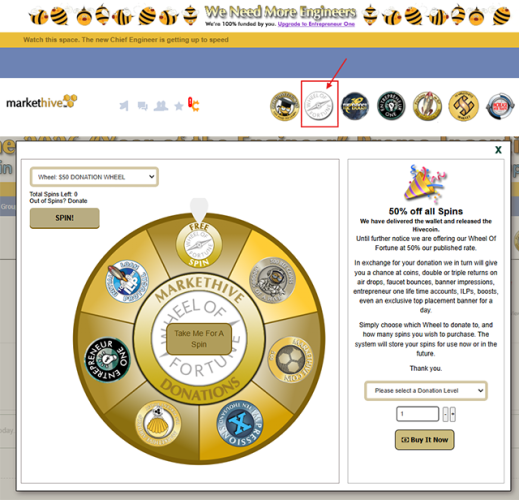
Many features of Markethive are still to be released later this year. One that has already launched is Wheel of Fortune, which highlights its gamified element. This interactive, gamified system is designed not just for fun, but to significantly benefit every participating community member by offering a diverse array of Markethive-related prizes. It transforms engagement into tangible rewards, driving activity and value within the platform.

A Spectrum of Valuable Prizes

With every spin, participants have the chance to win a bounty of Markethive assets, directly enhancing their presence and portfolio on the platform. The rewards include:

  • Hivecoins (HVC): The core cryptocurrency of the Markethive ecosystem, providing direct financial value and utility.
  • Bee Coins (BEEs): A micro-unit of Hivecoin, serving as an easily accessible fractional component. (Note: 100,000,000 BEEs are equivalent to one Hivecoin, much like a Satoshi relates to Bitcoin).
  • Ad Impressions: Valuable credits for running marketing campaigns on Markethive's internal Banner Impressions Exchange, (BIX) boosting visibility for businesses and profiles.
  • Airdrop Bumps: Multipliers that increase the volume of Hivecoin received during scheduled airdrops, accelerating crypto accumulation.
  • Newsfeed Boosts: Enhanced visibility for your content on the Markethive Newsfeed, ensuring your posts reach a wider audience.
  • Micropayment Boosts: Multipliers applied to the micropayments you receive within the Markethive system.
  • Initial Loan Protocol (ILP): The most coveted prize, offering a share in the platform's lifetime revenue. Spins can award partial or even a full ILP, opening the door to becoming a Markethive Shareholder.
  • Exclusive Top Placement Banner: A temporary, high-visibility advertising spot for a day, offering unmatched promotional value.
  • Entrepreneur One Lifetime Account: Full, premium access to the platform's features for life, including 1/10 ILP every year it’s active. 
  • Faucet Bounces: Enhanced returns on Markethive's built-in crypto faucet.

The Mechanism: A Donation-Based Win-Win System

The Wheel of Fortune is structured as a transparent, donation-based platform. Community members contribute at levels 1 through 5, ranging from $1 USD to $100 USD. 

The fundamental principle governing the system is simple: The number of spins and the potential value of the prizes are directly proportional to the chosen donation level. Higher donations yield more spins and access to larger prize brackets. The system provides a fundamental guarantee: "Every Spin is a Win!" Participants are assured of a benefit for their contribution, as there are no "lose" outcomes or empty slots. At the very least, a participant will win a free spin to try again.

Your Donation Translates to Exponential Returns

In exchange for your support via a donation, you receive immediate chances to win, which often translate into superior returns, including:

  • A chance to win substantial HVC amounts.
  • Double or Triple Returns on upcoming airdrops.
  • Significant boosts to your advertising impressions and newsfeed visibility.
  • The life-changing opportunity to win a fractional or full ILP, securing your status as a lifetime revenue-earning Markethive Shareholder.

Exclusive Limited-Time Promotion

To celebrate the launch and encourage broad participation, Markethive is offering an exceptional promotion: Until further notice, the Wheel of Fortune is available at a massive 50% off the published donation rate. This significantly lowers the barrier to entry, making it an ideal time to maximize your spins and potential winnings.

How to Get Started

You will find the Wheel of Fortune by clicking its icon in the tray at the top of the home page. Participating is quick and easy. To begin your journey toward crypto accumulation and potential lifetime revenue: 

  1. Select Your Wheel: Choose the desired donation level (Wheel) you wish to contribute to.
  2. Choose Your Spins: Determine the number of spins you want to purchase.
  3. Spin and Win! The system conveniently tracks and stores your purchased spins, which you can use immediately or save for later.

The Wheel of Fortune marries the fun of gamification with the serious opportunity to build wealth. It is a strategic tool for community members seeking to rapidly grow their crypto portfolio while offering the chance to achieve the pinnacle of Markethive membership as a lifetime revenue earner with an ILP. 

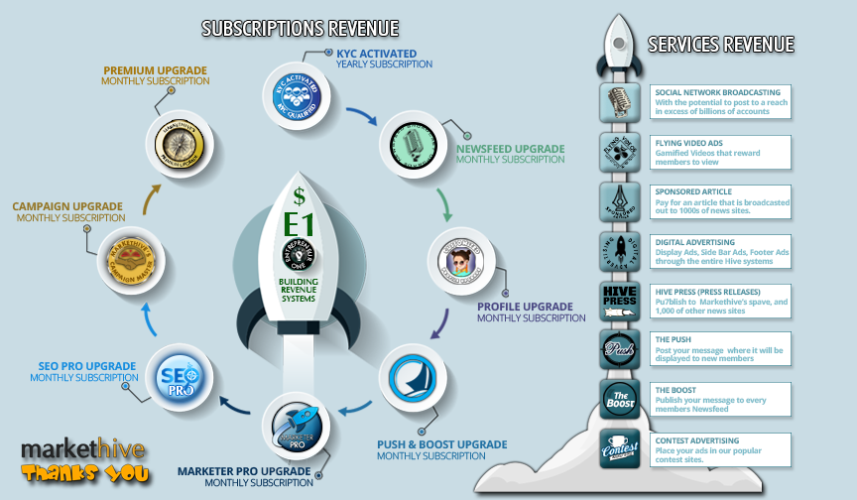
Your donations also support Markethive’s ongoing iterations, including scaling the infrastructure, expanding the feature set, improving the user experience, and completing the ecosystem’s build-out of the revenue system, which encompasses the retail side of our products and services, ensuring Markethive's continued leadership in the decentralized market network space.

Are you taking advantage of this dynamic feature and the daily opportunities it offers? Why not give it a spin? Not only are you rewarded with assets that will be extremely valuable in the foreseeable future, but you are also helping Markethive continue to build its God-given vision that millions of aspiring entrepreneurs worldwide desperately need. 

The Dual Benefit: Building Your Assets While Fueling a Global Vision

The rewards for your engagement are twofold and deeply impactful:

  1. Gaining Valuable Future Assets: The immediate benefit to you is the accrual of future assets within the Markethive ecosystem. These assets represent a stake in the platform's future growth and prosperity, creating a powerful engine for passive income and appreciation. You are not merely participating; you are actively investing in your own future portfolio with every action you take.
     
  2. Actively Supporting Markethive's God-Given Vision: Beyond your personal gains, your participation provides the essential momentum to advance Markethive's larger, profound mission. This vision is desperately needed by millions of aspiring entrepreneurs worldwide; a decentralized, fair, and empowering platform where small businesses, innovators, and creators can thrive without the stifling control or high costs of traditional Silicon Valley giants.

A Movement for Global Entrepreneurial Empowerment

Markethive's core mission is to build an ecosystem grounded in the principles of equitable wealth distribution and true digital ownership. The platform is designed to be the definitive 'entrepreneurial social market network,' a place where genuine economic freedom is possible. 

By participating in Wheel of Fortune, you become a critical part of achieving this grand humanitarian goal, ensuring that every entrepreneur, regardless of location or starting capital, has the tools and community needed to turn their aspirations into reality. Your daily engagement is a decisive vote of confidence and a direct contribution to democratizing global entrepreneurial opportunity.

You are invited to join a powerful movement and actively contribute to the unfolding of this transformative vision, while simultaneously positioning yourself to receive substantial incentives for your dedicated support and participation.

This article is designed to provide a comprehensive understanding of Markethive, exploring the profound reasons its foundational principles and ambitious goals are considered a divinely inspired vision - a framework rooted in a higher purpose. It meticulously details the multifaceted steps we can collectively take to nurture and sustain this endeavor. 

Furthermore, it establishes a framework for patient anticipation, recognizing that the full and glorious realization of Markethive's immense potential, and with it, the manifestation of your own eventual, well-deserved prosperity, is intrinsically tied to and dependent on God's perfect timing. Our commitment is to work diligently in the present while maintaining faith in the future, understanding that the most significant rewards await those who align their efforts with divine providence.


The Growth of Gamification at Markethive: Get Ready for Video Flying Ads - The Wheel of Fortune Is Already Turning: The Growth of Gamification at Markethive: Get Ready for Video Flying Ads - The Wheel of Fortune Is Already Turning ...

Wednesday, January 29, 2025

Markethive: A Beacon of Hope for Entrepreneurs in a Digital Age

Markethive: A Beacon of Hope for Entrepreneurs in a Digital Age: In a world where centralized platforms dominate, privacy is a luxury, and creators struggle to own their voice, Markethive emerges as a revolutionary force—a blockchain-powered sanctuary b...

Monday, January 27, 2025

Blockchain, Crypto, and Stablecoin: Revolutionizing the Future of Digital Finance

Blockchain, Crypto, and Stablecoin: Revolutionizing the Future of Digital Finance: The rapid evolution of digital finance has introduced groundbreaking technologies like blockchain, crypto, and stablecoins, transforming how we perceive and interact with money. These innovations are...

Saturday, April 22, 2023

The BitAdCoin purchase is possible from 00:00 27.04.2023 (London time)


I believe this will be the nex big thing !

** The BitAdCoin purchase is possible from 00:00 27.04.2023 (London time).

We have already concluded over 200 contracts with advertising platforms and service providers. Who will use our token as a means of payment after the ICO.
https://bit.ly/bitadsclick
** Buy pre-ICO for $0.04 and sell post-ICO for a minimum of $4
After the ICO, the BitAdCoin will be listed on 4 major exchanges, and these contracts have already been concluded. The BitAdCoin will then cost $4 on the exchange.
Of course you can also sell the purchased tokens in our BAC shop for a minimum of $4. After the ICO, all advertising platforms and service providers will buy the BAC token in our shop.

** Start of PRE-ICO April 27, 2023 to May 7, 2023
From here you can buy the BitAdCoin for $0.04. There are then 3,000,000 BAC for sale.

https://bit.ly/bitadsclick

** IMPORTANT! The 3,000,000 BAC tokens may be sold within 4-6 days, or within 15 hours.
You can find more information about the Pre-ICO and ICO on the website or in the back office (start date, costs, etc.).

** TOP affiliate program
Level 1 - 20%
Level 2 - 5%
Level 3 - 3%
Level 4 - 1%
Level 5 - 1%
(the bonus is paid in BTC, LTC, TRX, ETH, USDT)

** ICO bonus program
When buying BAC tokens during the PRE-ICO and ICO period, you will also get a bonus.
The higher the investment amount, the more bonus you get.
$5 - $25 (0%)
$25 - $100 (10%)
$100 - $500 (15%)
$500 - $2,000 (20%)
$2,000 - $5,000 (30%)

You can only win!
https://bit.ly/bitadsclick
team bitadcoin

Tuesday, April 11, 2023

The Trust Crisis Of Banks Worsens Ensuing Initial Collapse Of SVB. A Plus for Crypto


The Trust Crisis Of Banks Worsens Ensuing Initial Collapse Of SVB. A Plus for Crypto

The US banking sector is facing a crisis of trust following the collapse of Silicon Valley Bank, which has left many Americans, particularly those without insurance for their deposits, anxiously trying to determine if their money is safe. A recent report found that more the 186 banks, or 5% of all banks in the country, are in danger of failing. The article outlines the analysis, identifies the risk factors to watch out for, and explains why investing in cryptocurrency could be a genuine safe-haven option.


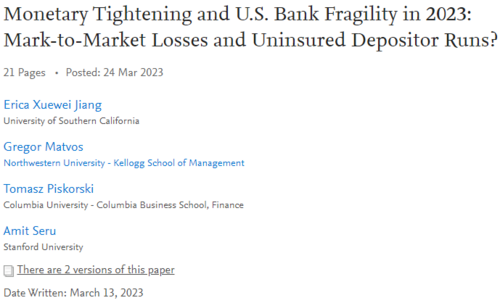
Source: SSRN Papers-Full Study

As the above screenshot shows, the study is titled ‘Monetary Tightening and US Bank Fragility in 2023; Mark-to-Market Losses and Uninsured Depositor Runs?’  It was written by four academics from distinguished universities in the United States on March 13th, 2023. 

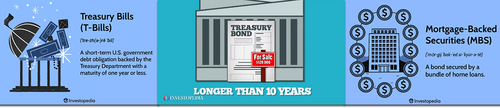
The report begins with a brief explanation of why so many US banks are at risk of going under and pertains to all the assets banks hold on their balance sheets. These are US bonds (US government debt) and mortgage-backed securities (MBS) (bundles of mortgages). US Bonds and MBSs are the safest assets a bank can hold, at least according to regulators, and why banks tend to invest most of their customers' deposits in US bonds and MBSs.


Images sourced at Investopedia.com

These assets earn interest for the banks and thus make it possible for them to offer services with low or no fees. However, when interest rates rise, the value of US bonds and MBSs decreases. The reasons for this are many, but the main takeaway here is that higher interest rates result in US bonds and MBSs crashing. If the value of these assets falls too much, banks can become temporarily insolvent. 

This insolvency is temporary because when US bonds and MBSs mature, meaning the loan terms end, the bank receives the total value of the underlying asset. Again, the mechanics of this are many, but just know that US bonds and MBSs don't lose money if they are held to maturity, and why banks don't report the losses on US bonds and MBSs when interest rates rise. 

Most information about losses on debt securities held by banks is immersed in the glossaries in their SEC filings. It is not considered a significant problem until that bank has major liquidity issues. It’s because it's not a loss until they sell, and in the case of US bonds and MBSs, they won't lose anything if they hold them to maturity. 

This accounting practice is arguably controversial. These so-called unrealized losses are acceptable if the bank isn't forced to sell any of these assets at a loss, specifically customer withdrawals.  It’s what happened to SVB and why it sank. However, there is one crucial detail to keep in mind. 92.5% of SVB's deposits were uninsured by the Federal Deposit Insurance Corporation (FDIC). 

For context, the FDIC only ensures bank deposits up to $250,000 per account. Any amount above that is considered uninsured. SVB experienced a bank run because its uninsured depositors could see that it had many unrealized losses. This led to speculation that SVB didn't have enough money to honor all withdrawals. 

As such, this bank run may not have happened if most deposits were insured, i.e., under $250K per account. SVB had so many uninsured deposits because the bank provided accounts and banking services primarily to small and medium-sized businesses, startups, and entrepreneurs in Silicon Valley. These clients typically require lots of cash liquidity to pay their employees, make acquisitions, etc. 

Around $9 trillion of bank deposits in the United States are uninsured, roughly 50% of all bank deposits. Banks have been happily investing these uninsured deposits into US bonds and MBSs. The problem is that interest rates have risen, and their unrealized losses have proliferated. At the end of 2022, US banks collectively had unrealized losses totaling more than $600 billion. Interest rates have risen more since then, so these losses are likely even more prominent now.

In short, US Banks have lots of unrealized losses and also lots of uninsured depositors who are concerned that banks can't honor withdrawals because of these unrealized losses. The authors examined over 4,000 banks in the study to see which ones were most at risk and why. 


Unrealized Losses

First, the study highlighted that 42% of all bank deposits had been invested into regular MBSs, with another 24% invested in commercial MBSs, i.e., commercial real estate loans, US bonds, and other asset-backed securities (ABS). The authors then tried to calculate the unrealized losses on these assets. After crunching the numbers, the authors found the following, 

“The median value of banks' unrealized losses is around 9% after marking to market. The 5% of banks with worse unrealized losses experience asset decline of around 20%.” 

Note that ‘marked to market’ means ‘assuming sold today.’ In lay terms, the average American Bank has unrealized losses of around 10%, and 5% of the most vulnerable banks have unrealized losses of 20%. 

So if depositors were to rush and withdraw from these banks, they would get 90% of their money back at the average bank and 80% back at a vulnerable bank. Not surprisingly, these unrealized losses were the smallest for Global Systemically Important Banks (GSIB), including JPMorgan and Bank of America. GSIBs have less than 5% of unrealized losses. The average non-GSIB has 10% unrealized losses, and SVB wasn't even the worst. 

The authors found that more than 11% of US banks had larger unrealized losses than SVB when it collapsed. They estimate that as many as 500 other banks could have failed based purely on unrealized losses. The reason why only SVB went down was because of the high number of uninsured deposits. The authors then provide a series of scenarios to showcase how uninsured depositors could react to rising interest rates.


Uninsured Depositors Waking Up

The first scenario assumes that the uninsured depositors stick around and wait. The other three scenarios surmise they withdraw and invest in other assets, which provides a higher interest rate than a savings account. Understand that insolvency fears related to unrealized losses aren't the only reason why uninsured depositors withdraw money from a bank. 

The primary reason why they would do this is that they want to earn a high-interest rate on their large deposits. This desire for yield increases as interest rates rise. Unfortunately for the banks, it's hard for them to provide competitive interest rates on savings accounts without losing lots of money. This is why many US banks haven't increased their interest rates on savings accounts, despite interest rates increasing. They’re making lots of money off their depositors. However, if they were to raise interest rates on savings accounts, they wouldn't make nearly as much money. 

In the study, the authors assume that most uninsured depositors are sleepy, meaning they aren't rushing to withdraw to earn a higher interest rate elsewhere. However, this is starting to change; besides the banking crisis, the high-interest rates that are still rising in other regions tempt those sleepy uninsured depositors into waking up and moving their money elsewhere. If they do this, banks with large, unrealized losses will start going under as they won't be able to honor all withdrawals. 


How Many Banks At Risk?

Naturally, the authors assess whether banks have enough assets to honor these upcoming withdrawals from uninsured depositors. They assume that the FDIC doesn't close down banks that come under stress, which is significant because the FDIC is likely to do this if banks start getting squeezed. 

The good news is that all bar two American banks have enough assets to honor withdrawals from uninsured depositors. The bad news is that the authors don't specify which two banks are at risk, but they conclude that this little risk means additional bank runs are unlikely for the time being. 


For Good Measure

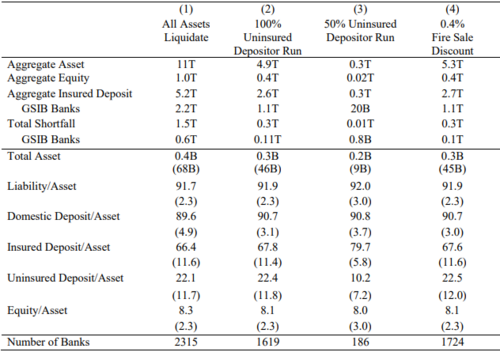
As an extra, the authors analyzed the possibility of what would happen if uninsured depositors ran. They did a number of simulations of bank runs, from 10% to 100% of uninsured depositors withdrawing their assets. 


Source: SSRN Papers-Full Study

What's concerning is that the ten banks most at risk of experiencing a bank run are large. As the authors cite in the study, 

 “The risk of run does not only apply to smaller banks. Out of the 10 largest insolvent banks, 1 has assets above $1 Trillion, 3 have assets above $200 Billion (but less than $1 Trillion), 3 have assets above $100 Billion (but less than $200 Billion), and the remaining 3 have assets greater than $50 Billion (but less than $100 Billion).” 

Unfortunately, the authors don't specify which banks these are but reveal how sensitive US banks are to bank runs. They concluded that even if just 10% of uninsured depositors withdrew their money from banks, 66 banks would go under. If 30% of uninsured depositors withdrew their money, 106 banks would go under. If half of all uninsured depositors ran, 186 banks would fail. This underscores that at least a few dozen banks are at risk of going under over the coming months. 

This is ultimately due to the fatal combination of significant unrealized losses due to rising interest rates and withdrawals from uninsured depositors seeking higher yields from these rates. The final simulation was if 100% of uninsured deposits withdrew all their assets from US banks. They insisted that this simulation is worth doing to assess the state of the US banking sector. Surprisingly only about half of US banks would go under. 

The authors then conclude by highlighting that the value of assets held by US banks is more than $2 trillion lower than what's being reported, thanks to unrealized losses-based accounting. They reiterate that hundreds of banks are at risk of going under if uninsured depositors withdraw. They warned that even small numbers of withdrawals from uninsured depositors could lead to unrealized losses being realized. This would lead to more bank runs, evolving into an even bigger banking crisis than we've seen. They go as far as to suggest regulations to address this. 

For starters, banks should start changing how they report their unrealized losses so that bank depositors have a better sense of how underwater their banks are. Because of the lack of transparency, the authors manually calculated these unrealized losses using complex maths. The authors acknowledge that this won't solve the insolvency risks many banks face, so they recommend that banks be forced to increase their capital requirements. 

This coincides with what Michael Barr, the Fed’s Vice-chair for Supervision, has been busy doing. Michael had been examining capital requirements for banks before the banking crisis began. Maybe he saw the banking crisis coming or was preparing to take advantage of it to introduce regulations. Michael Bar’s anti-crypto speech indicates the second possibility is the most likely. Michael has been desperate to increase his powers, presumably to consolidate the banking sector to assist in the rollout of a central bank digital currency


Be Vigilant of The Risk Elements

Which risk factors should you be aware of when analyzing banks? I am not a financial adviser. Still, my research into this convoluted accounting system revealed that the two main risk factors are unrealized losses and uninsured deposits. It is at risk if your bank has many unrealized losses and uninsured deposits. The problem is that it takes work to estimate these unrealized losses. Moreover, not all uninsured deposits are prone to flight. Remember that most of them are required to pay employees at small companies. 

Also, as mentioned above, most banks with many uninsured deposits tend to be smaller, i.e., not GSIBs. In theory, this makes them inherently riskier than GSIBs. In practice, though, when a non-GSIB goes under, it gets acquired by a GSIB. This means your assets could be safer at a small bank. If you read the article about bank bail-ins, you'll know that GSIBs can be risky. 

If a non-GSIB goes under, it gets acquired by a big bank, and customer deposits are kept, but if a GSIB goes under, customer deposits are used to bail them out. As recently happened with Credit Suisse and its takeover by UBS. The arguably political deal required capital from somewhere to satisfy UBS. According to WSJ, the Swiss government was desperate to avoid the appearance that this was a taxpayer-funded bailout.

GSIBs are also more likely to comply with investment ideologies, like ESG. As discussed in this article, the Bank of America is one of the big institutions behind the ESG movement. Some of its affiliates are introducing individual ESG scores for their customers. 

Small banks may also have challenges because around 80% of commercial real estate loans come from small banks. In addition to being wrecked by higher interest rates, commercial real estate is struggling because people must return to the office. 50% of office spaces in the US are empty. This means that small banks are at a higher risk of sitting on larger unrealized losses, which is consistent with the findings of the study. 

If that weren't bad enough, these losses would likely increase as time passes, even if interest rates start coming down because work from home is probably here to stay. Even if uninsured depositors are less likely to withdraw from small banks due to the purpose of these deposits, just a small number of withdrawals could therefore cause severe issues for small banks. 

The findings of the study suggest this risk is already there. All it takes is 10% of uninsured deposits to move. In sum, small and big banks come with their own risks, and it's up to you to decide which risks you'd instead take. Diversifying your deposits is an option, but the fact that every bank operates using this fractional reserve model means your money will never be genuinely risk-free in their coffers. 


Image credit: Markethive.com

Cryptocurrency To The Rescue

This is where cryptocurrency comes in. Cryptocurrencies ostensibly have only one risk: their current price volatility. There are, of course, risks associated with things like improperly written code, but the largest and most established cryptocurrencies have been battle tested every day for over a decade. 

Aside from that, cryptocurrencies are one of the best hedges against the banking system. When you hold a cryptocurrency, there is no counterparty risk. That crypto is genuinely yours, and there isn't some greedy banker going and investing your crypto into a basket of risky, commercial real estate loans behind your back. 

This characteristic alone makes cryptocurrency valuable. Also, cryptocurrency lets you send a transaction to whoever you want, whenever you want, and for however much you want. This is the true definition of financial freedom, and its importance was fully displayed when Nasdaq halted the trading of bank stocks during the recent banking crisis. 

Nobody can turn off the decentralized cryptocurrency exchange and prevent people from trading. You will always be able to trade. Take a second to consider; that blocking transactions, halting trading, and freezing assets will only become more common as CBDCs are rolled out. This will make the financial freedom aspect of cryptocurrency ever more critical, along with the decentralization that underlies it. 

Without decentralization, crypto's value proposition quickly disappears. That's why instead of wasting time assessing the unrealized losses and uninsured deposits of banks, you should learn about what makes a cryptocurrency genuinely decentralized. After all, the days of commercial banks are numbered; the thousands of existing banks will inevitably consolidate into a handful of mega banks, and governments will nationalize these mega banks. 

Financial freedom in the traditional financial system will be gone when that happens. At the same time, economic freedom in the crypto ecosystem will only continue to grow. By the grace of God, it will rise to the point that it's capable of accommodating the billions of people who will pull out of the traditional financial system as it becomes ever more centralized and ideological. 

Both monetary mechanisms will take years to play out, but it's already clear that the global financial system is splitting into two structures: free and sovereign and one that is not. You now have the once-in-a-millennium opportunity to choose which system to participate in. It’s critical to make that decision before it's made for you. 

This article is provided for informational purposes only. It is not offered or intended to be used as legal, tax, investment, financial, or other advice.


Editor and Chief Markethive: Deb Williams. (Australia) I thrive on progress and champion freedom of speech. I embrace "Change" with a passion, and my purpose in life is to enlighten people to accept and move forward with enthusiasm. Find me at my Markethive Profile Page | My Twitter Account | and my LinkedIn Profile.


Also published @ Substack.comBeforeIt’sNews.comSteemit.com.


The Trust Crisis Of Banks Worsens Ensuing Initial Collapse Of SVB. A Plus for Crypto: The Trust Crisis Of Banks Worsens Ensuing Initial Collapse Of SVB. A Plus for Crypto ...

Sunday, April 10, 2022

How To Increase Your Sphere Of Influence In Markethive 

How To Increase Your Sphere Of Influence In Markethive 


We have a lot to be grateful for within Markethive. It’s like stepping out of the rat race into an oasis of humanity at its best. As an inbound marketing, business-based platform with an inherent entrepreneurial spirit, we have all the tools to get our message out to the whole world. We have a social media interface with a collaborative ethos rarely experienced on legacy social media. 

We are starting to see new integrations in the blogging section in preparation for the customized, more intuitive interface and dashboard of Markethive and, of course, the Markethive Wallet that will facilitate the Merchant accounts for members as well as personal transactions, the Vault, etc. 


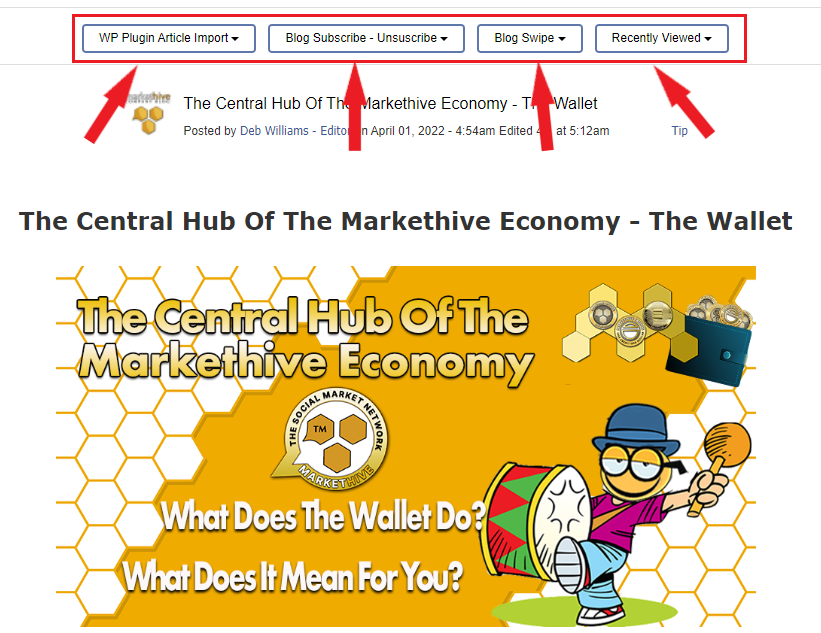
Image: Updated feature above all Blogs

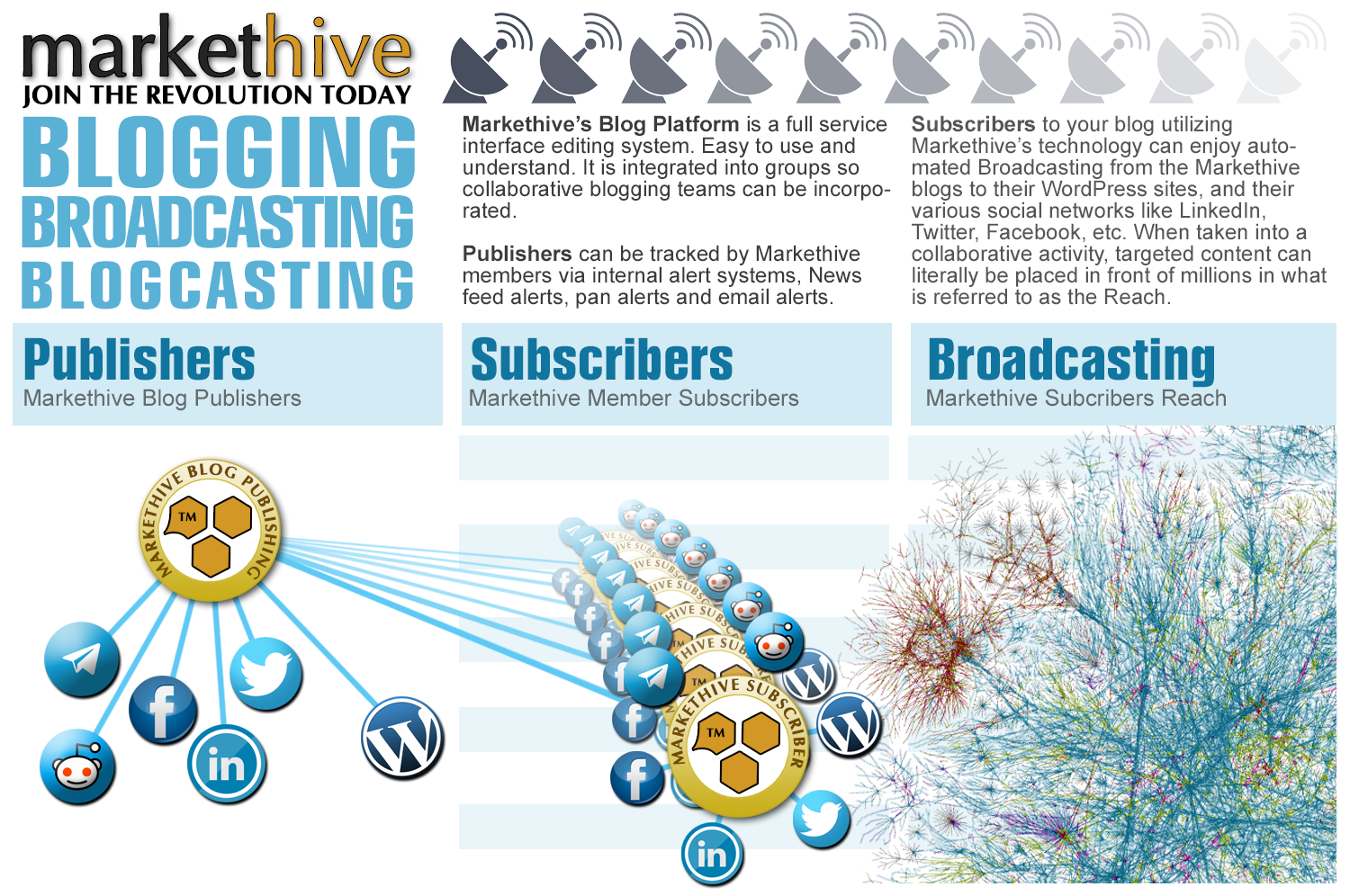
As shown above, the new-look Blogcasting Hub is located at the top of all blogs in the system. Blogcasting is a term introduced by Markethive and is an enhanced broadcasting system. In the traditional broadcasting sense, only the people who physically subscribe to your blog or newsletter are usually notified of your updates via email. 

With this blogcasting system, your social networks are informed of your blog as and when you publish them. What this means is the potential reach is into the millions.  

For example, If I subscribe to your blog and have 20,000 followers across all my social media accounts, and you have 15,000 subscribers each with a similar following, your blogs have now been potentially seen by around 300,000,000 people. These are people who are not directly subscribed to you. It is known as a “reach” and is extremely powerful. 


WP Plugin Article Import

When you use the Markethive blogging system, your content can easily be distributed to your and others’ WordPress sites who subscribe to you. WordPress has been around for years and is a renowned world leader in Blogging platforms. 

It will be integrated into the new Page Making system where all member accounts will receive a WordPress site and be assigned an email for both POP email and default website with an option to assign it to your WordPress or Markethive capture page. 

Markethive’s “Blogcasting” is an excellent solution to the long-term problem of getting the word out legitimately to people who want to hear what you have to say. Blogging is the purest essence of inbound marketing and the core of what Markethive does. 


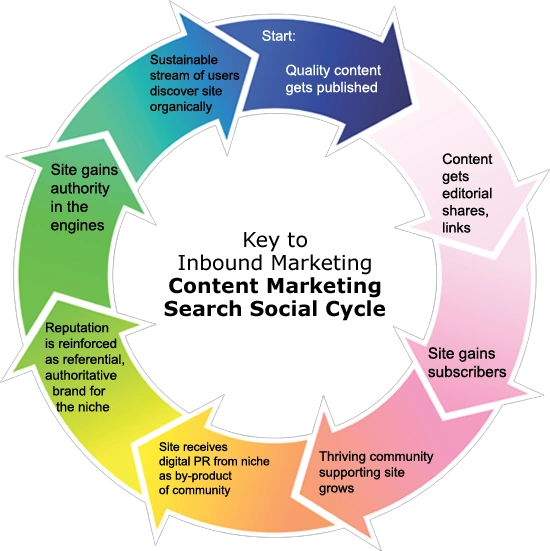
Image: Inbound Content Marketing Wheel


Blog System In Your Storefront Niche

Markethive has successfully combined all the technical and tactical aspects and requirements into one system and overcame the obstacles to make blogging a group process. You can mentor your new associates or offer your customers ongoing support through your Storefront Group. 

Connecting with them through writing blogs and articles consistently with exciting and relevant information will create an authoritative presence, perhaps meet a customer’s need and provide a solution that maybe can’t be recognized in a short advertising message. It can start conversations and is an excellent way to be invited into the consumers’ hearts and minds. 

It helps us be more human in everything we do and in every engagement. It’s about building relationships and connecting at an authentic and genuine level. The most human company wins, and the technology should be used to help your company be more compassionate, receptive, fascinating, and valuable.

Markethive’s Inbound Marketing platform delivers a blogging system built for the beginner, sophisticated for the intermediate, and a compelling platform that advanced professional bloggers will appreciate. The system is designed to develop a complete blog system effortlessly, and easily set up to be the engine that powers your WordPress blogs. 


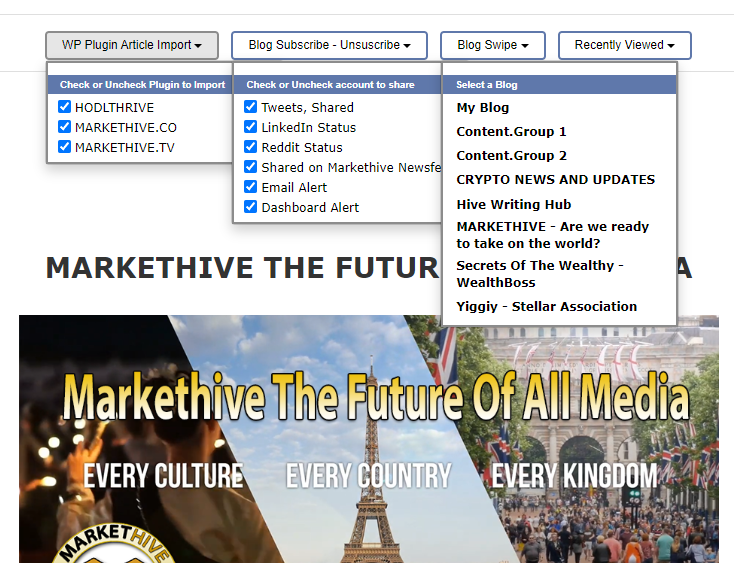
Image: Drop-down menus on Blogging Platform


Blog Subscribe 

The Blog Subscribe feature is where other Markethive members can subscribe to your blog by checking the status of any medium displayed in the drop-down menu. Other sites are to be added, subject to alignment and collaboration of the parties in question going forward. 

When they subscribe (and the potential is 1000s of them), your blog posts are automatically posted to their newsfeeds, email, and any social media accounts they’ve checked. This provides a downstream of subscribers, fellow entrepreneurs at Markethive, who expose their connections to your message; they lift you, increase your popularity, and build more outstanding branding. 

When your blogs are shared and consequently clicked on, they move up in the search rankings. Your readers will want others to know if you're providing quality content. Of course, the only way to make sure your blogs contribute to your website’s popularity is to create unique content, provide answers for visitors, and then share your blogs wherever you can. 

Through the News Feed and Blogcasting Hub, you can promote any products and services globally with a reach into the billions. That is because when people do searches, if the content on your blog is what they are after, they will find you. A very high percentage of the traffic is non-member-related, so many of the people you address on your blog do not even belong to the site.

 
Blog Swipe

The Markethive blog system allows you to make your content available to all members when set on Public upon publishing your blog. The other options are privacy, comments, and swiping are to your friends only, or just to members of all the Groups you belong to, or a selection of them or just one (your choice). You can also set it to Private so no one can swipe your blog.

Why? There are many sound reasons for this.

Curating: 

Content curation is the process of sorting through the vast amounts of content on the web and presenting it in a meaningful and organized way around a specific theme. The work involves sifting, sorting, arranging, and publishing information. Markethive offers features to the groups you create and is the perfect blogging platform. 

The option allows others to reproduce your work with your permission and automatically take an exact copy of your blog to their Markethive Blog System. WordPress plugin enables your blog articles massive syndication to other Markethive members' WordPress blogs.

Simply set up a Curating Group for yourself and Swipe the blogs in Markethive as a collection of content you may want to use in your publications. The new Markethive interface will house a newsfeed specifically for curation to intuitively organize and further our reach. 

Proofing: 

You may have a group of members who want to edit, add, or rewrite your content. It is an active phenomenon in Markethive, offering mentorship to people keen to learn the art of writing and blogging, advancing their presence. 

You may get critiques when you produce a blog, so I just offer them to swipe it, edit and change it as they see fit, and then let me know. If I like it, I swipe it back. It’s all about perpetual learning and the ability to express yourself within a collaborative culture. 

The ability to swipe a Blog makes it so much easier to get started, and new bloggers go from poorly and rarely produced blog posts to 1 or 2 dynamic and excellent on-topic blog posts daily. In other words, thanks to the collaborative culture and mentorship, Markethive is now churning out a new breed of wonderful and dynamic bloggers. 

Cocktails: 

A Markethive feature allows you to create unlimited groups, each with a different cocktail of content curated, aggregated, or from multiple group memberships. So the options to produce unique content for unlimited WordPress blogs controlled from within Markethive are unlimited.


Image: Blogcasting Infographic


Ecosystem For Entrepreneurs With Respect

Markethive is blockchain-driven, being integrated on the Solana Blockchain. The Markethive coin is mined when members utilizing the platform as the system rewards you with the Hivecoin Token for using the platform as intended. 

It’s important to note that excessive non-productive actions and engagement for the sole purpose of accumulating the token are not rewarded. Measures have been put in place for fraudulent behavior, which is considered toxic for the professionalism of the platform.  

With all members' creative content in mind, distributed, peer-to-peer data, communications, broadcasting, and marketing foundation are advantages. With distributed decentralized cloud servers, the likelihood of a data crash, central server failure, hacking, and political unrest is heavily mitigated, delivering an extremely stable platform for each subscriber on their merit.


Another Advantage Coming

Blogcasting is a Blogging Broadcasting System introduced and enhanced by Markethive. When you use the Markethive blogging system, your content can easily be distributed to your and other WordPress sites. 

Markethive has also built into the system the ability to register your other social network accounts, with more being added as we move forward with the new interface. You can subscribe to your blogs and others, therefore literally distributing content to a vast reach into the billions. 

The added advantage is the Bounty Program that is currently in the works. This means you will be rewarded for registering all your separate accounts through the Markethive platform. Subscribing and following the many Markethive social media accounts will qualify you for the Infinity Bounty Program. 

CEO of Markethive Thomas Prendergast explains the workings and benefits of the upcoming Infinity Bounty Program. 


Regardless of your motivation and drive, Markethive will add to your objectives, broaden your reach, and build your sphere of influence further and more significant than anything before has even attempted to do.

The moment you join Markethive, you have an instant setup of your own “Viral Blog” ready for you to begin posting content and marketing your business, product, service, or even personal content. You’ll be up and running the moment you set up your account! Markethive nurtures the Rise of the Entrepreneur with the Divine Vision to put a great future in your hands.


ecosystem for entrepreneurs


Also published @ BeforeIt’sNews.com https://beforeitsnews.com/promotional/2022/04/how-to-increase-your-sphere-of-influence-in-markethive-3034.html


How To Increase Your Sphere Of Influence In Markethive : How To Increase Your Sphere Of Influence In Markethive  ...